

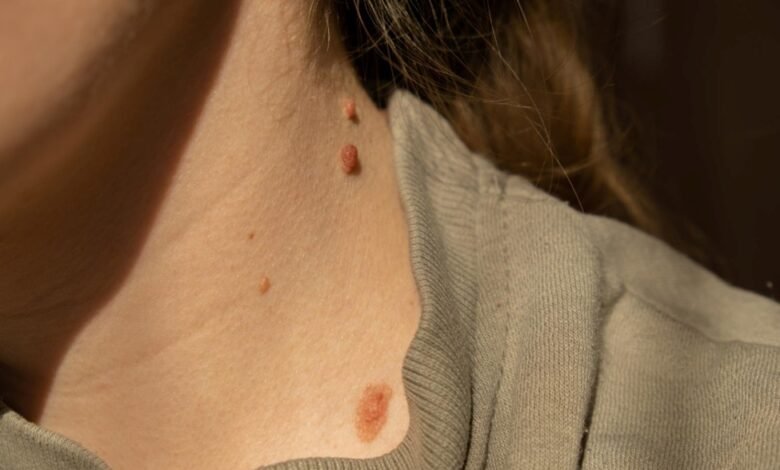
You’re getting dressed one morning and notice a small, bright red dot on your torso — perfectly round, as vivid as a drop of red ink. You don’t remember it being there last month. You press it gently, and it blanches slightly, then flushes back. It doesn’t hurt. It doesn’t itch. But it’s there, and now you can’t unsee it.
That’s a cherry angioma — one of the most common benign skin growths in adults over 30. While completely harmless from a medical standpoint, they can multiply over time and become a cosmetic concern, especially when they appear on the face, neck, or décolleté. Understanding what they are, why they form, and what your removal options look like is the first step toward making an informed decision.
What Is a Cherry Angioma?
A cherry angioma is a small, benign overgrowth of blood vessels near the surface of the skin. Also called Campbell de Morgan spots, they typically appear as bright-red, dome-shaped papules ranging from 1 to 5 millimeters in diameter. Some remain flat; others develop a slightly raised, rounded profile.
They’re found most often on the trunk, arms, and shoulders, though they can appear anywhere. The characteristic red or purple hue comes from a dense cluster of dilated capillaries just beneath the skin’s surface — the vivid red blood spots on skin that many people describe when searching for what they’re looking at.
What Causes Cherry Angiomas?
The precise mechanisms underlying cherry angiomas aren’t fully understood. Research points to genetic predisposition, age-related vascular changes, and hormonal fluctuations as the primary drivers. Contributing factors include age (prevalence increases sharply after 30), family history, hormonal changes such as pregnancy, and prolonged sun or chemical exposure.
Cherry angiomas are not contagious, not cancerous, and, in most cases, not a sign of underlying disease. That said, if a growth changes color, bleeds spontaneously, or develops an irregular border, a professional evaluation is always the right call.
How Do You Know It’s a Cherry Angioma?
Most are easy to identify by appearance: bright red, cherry-red, or purple in color; smooth, round surface (flat or slightly raised); 1–5 mm in diameter; partially blanches under pressure; painless and non-itchy.
A growth that doesn’t fit this profile — one that bleeds without trauma, grows rapidly, or shows irregular pigmentation — should be assessed by a qualified skin care professional before any removal is considered.
Cherry Angioma Treatment Options: What Actually Works
Cherry angiomas do not go away on their own, and no topical cream or home remedy has been proven to eliminate them. Clinical intervention is the only reliable path. The three most widely used cherry angioma treatment approaches are:
Electrocoagulation: A fine-tipped probe delivers a controlled electrical current directly to the lesion, cauterizing abnormal blood vessels and causing the angioma to resolve within days. The procedure takes only a few minutes per lesion, requires minimal downtime, and leaves minimal scarring when performed correctly. This is one of the most precise methods available and is widely offered at medical aesthetics clinics in Montreal.
Cherry Angioma Laser Removal: Pulsed dye laser and other vascular lasers target the hemoglobin within the angioma’s blood vessels, selectively destroying them without damaging surrounding skin. Cherry angioma laser removal is particularly well-suited for multiple lesions in a single session and for precision areas like the face or neck. Most patients see complete clearance after one or two sessions.
Cryotherapy: Liquid nitrogen is applied to freeze and destroy the abnormal tissue. Fast, anesthesia-free, and effective for smaller superficial lesions — though it can cause temporary pigmentation changes in darker skin tones, and re-treatment may be needed for larger lesions.
What to Expect Before, During, and After Removal
A proper skin assessment precedes any intervention: a trained professional examines each lesion to confirm it’s a cherry angioma and rules out anything requiring a referral. The procedure itself is brief — most single-lesion removals take under five minutes. Afterward, the treated area may appear red, slightly swollen, or form a small scab, all of which are normal. Keep the area clean, avoid sun exposure, and resist picking at any crust.
On cherry angioma removal cost: prices vary by the number of lesions, the method, and the clinic. Most provide a clear estimate during consultation. Removal is typically considered cosmetic and is not covered by provincial health insurance in Quebec.
Choosing the Right Clinic in Montreal
Look for a clinic that performs a proper pre-procedure assessment, is transparent about which method it recommends and why, and has experience treating the full range of benign skin lesions — including acrochordons (skin tags), milia, and other growths that often appear alongside cherry angiomas. Clinique Main d’Or, located in Saint-Laurent, offers exactly that breadth: a medico-aesthetic setting where our professionals evaluate each lesion before recommending a removal approach, whether electrocoagulation, laser, or cryotherapy.
Our consultation is always the right first step before committing to any procedure.
The Bottom Line
Cherry angiomas are benign, but that doesn’t mean you have to live with them. Effective cherry angioma removal options are available in Montreal with minimal downtime and predictable results. The key is choosing a qualified clinic that evaluates your skin properly before deciding on a method.
If you’ve had a cherry angioma removed — or you’re still weighing your options — what helped you make the call? Share your experience in the comments below.