

AI is no longer something that only lives in cloud tools or advanced software. It is now built into the devices people carry every day. Phones summarize messages, clean up photos, translate conversations, improve camera performance, and support smarter voice assistants. Tablets help with note-taking, design work, video editing, and multitasking. Earbuds adjust sound in real time. Even lightweight laptops and handheld gaming devices are becoming more powerful.
All of that convenience comes with a simple trade-off: more battery drain.
A basic backup battery may still help in an emergency, but it may not be enough for a full day of modern device use. People are no longer just charging one phone at the end of the day. They may need to keep a phone, earbuds, tablet, smartwatch, and work device running from morning to night. That shift makes charging speed more important than ever.
For commuters, travelers, students, remote workers, and content creators, a faster power bank is becoming less of a nice-to-have and more of an everyday essential. When your devices do more, your portable charger has to keep up.
What Makes a Power Bank Fast Enough for Modern Devices
Speed matters because not every portable charger delivers power the same way. A 20000 mah power bank may sound impressive, but capacity alone does not tell you how fast it can charge your phone, tablet, or laptop. Capacity tells you how much stored energy the power bank can hold. Output wattage tells you how quickly that power can move into your device.
For everyday phone charging, 20W to 30W may be enough for many users. That can give a phone a useful boost during a coffee break, commute, or lunch hour. Tablets usually need more power to charge at a comfortable speed. Compact laptops, gaming handhelds, and larger devices often need even higher wattage to charge properly while in use.
This is where USB-C Power Delivery becomes important. A usb c portable charger is useful because USB-C has become the standard for many newer phones, tablets, earbuds, handheld devices, and laptops. It also makes charging simpler. Instead of carrying several chargers and cables, many people can use one strong USB-C setup for most of their everyday devices.
A good fast power bank should offer a balance of capacity, wattage, port design, and smart power distribution. If it can charge multiple devices at once without slowing everything down too much, it becomes much more useful in real life.
Which Devices Benefit Most from a Faster Power Bank
Smartphones are the most obvious example. AI-powered photo editing, voice tools, real-time translation, navigation, video calls, hotspot use, and social media creation can drain battery quickly. A faster power bank helps you get meaningful battery life back in a short amount of time. That matters when you only have 20 minutes before your next meeting, flight, class, or ride.
Tablets also benefit from faster charging. Many people now use tablets as work tools, not just entertainment screens. They use them for presentations, drawing, reading, studying, editing photos, managing documents, and taking notes. When a tablet becomes part of your daily workflow, slow charging can interrupt your routine.
Wireless earbuds and wearables do not need huge amounts of power, but they still matter because people rely on them constantly. Earbuds are used for calls, music, meetings, workouts, and travel. A power bank with multiple ports can keep smaller accessories charged while your phone or tablet powers up.
Handheld gaming devices and compact laptops need even more attention. These devices often require higher output to charge efficiently, especially while you are using them. If your power bank cannot deliver enough wattage, the battery may charge very slowly or continue dropping during heavy use. For gaming, remote work, or long travel days, that can become frustrating fast.
How to Choose the Right Fast Power Bank
Start with wattage. If you mostly charge a phone, a lower-output model may be enough. If you also carry a tablet, gaming device, or laptop, choose a higher-output option that supports USB-C PD. This gives you more flexibility and helps your charger stay useful as your devices change.
Then think about capacity. For daily errands or commuting, a smaller power bank may be easier to carry. It can slip into a pocket, purse, or small backpack without adding much weight. For travel, long workdays, road trips, or multiple devices, higher capacity makes more sense. The goal is not always to buy the biggest model. It is to choose one that fits how you actually use your tech.
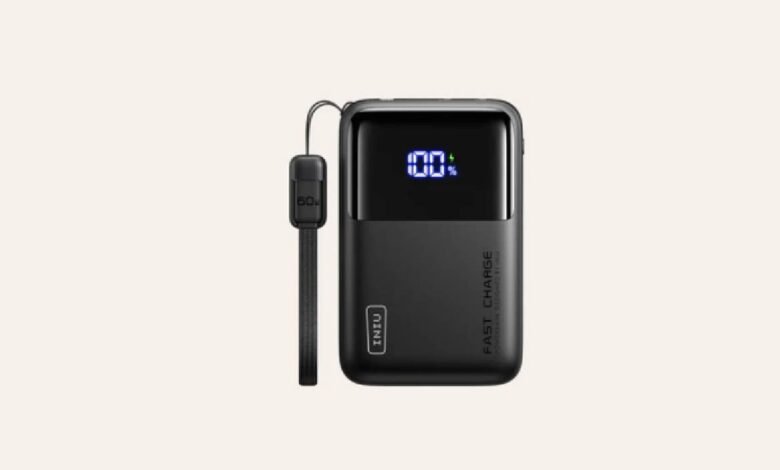
For example, a model like the INIU Pocket Rocket P50 45W Mini Power Bank can be a practical fit for people who want dependable backup power in a smaller, easier-to-carry design without making their everyday carry feel overly complicated.
Ports matter too. A good power bank should make charging simple, not add more clutter. Multiple ports are helpful when you need to charge a phone and earbuds at the same time, or when you want to share power with someone else. Built-in cables can also be useful if you often forget to pack one.
Safety should not be overlooked. Look for protection against overheating, overcharging, short circuits, and excessive current. A reliable fast charger should deliver speed without making you worry about your device. This is especially important when you use the power bank with expensive phones, tablets, laptops, or travel gear.
Common Mistakes to Avoid When Buying a Fast Power Bank
One common mistake is focusing only on battery capacity. A large number on the box does not always mean a better experience. If the output is too low, even a high-capacity model can feel slow. For modern devices, charging speed and power delivery can matter just as much as total capacity.
Another mistake is ignoring cable quality. Fast charging usually requires the right cable. A weak, damaged, or outdated cable can limit charging speed, even when the power bank itself supports higher output. If your device is charging slower than expected, the cable may be the reason.
Some people also buy more power than they need. A heavy power bank may be useful for long trips, but it can feel annoying for daily carry. If you only need a quick phone boost during the day, a slimmer option may be the smarter choice. Bigger is not always better when portability matters.
It is also easy to overlook device compatibility. Not every device charges at the same speed, and not every power bank supports the same charging standards. Before buying, check what your phone, tablet, or laptop can actually accept. That way, you are not paying for charging power you cannot use.
Conclusion
AI devices are making everyday tech more useful, but they are also raising the demand for reliable charging. Phones, tablets, earbuds, laptops, and gaming devices all use power in different ways. When these devices become part of your work, travel, entertainment, and daily routine, slow backup charging can quickly become a problem.
A faster power bank helps you stay connected, productive, and ready throughout the day. The best choice comes down to wattage, capacity, USB-C compatibility, port design, portability, and safety features. As AI-powered devices become more common, choosing the right portable power source is no longer just about convenience. It is about keeping up with the way people actually use technology now.