

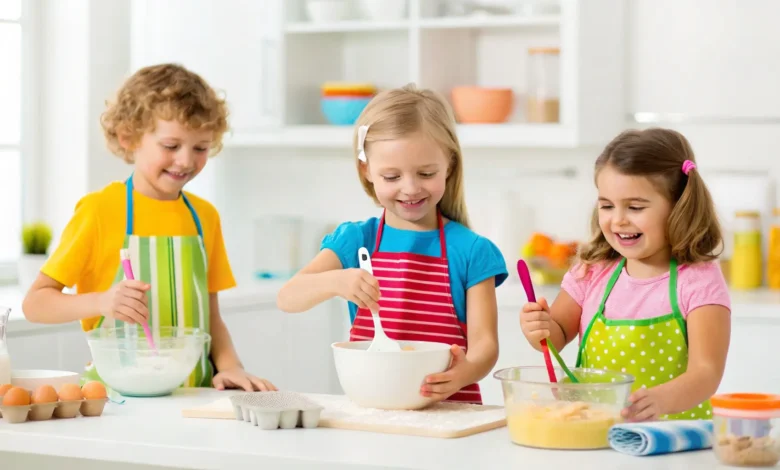
You can always spot the kids who dream of wearing a big white hat and cooking up their finest imaginary dishes for everyone they love. They’re the ones who gravitate toward play kitchens from the moment they can toddle over to one — Easy-Bake oven in hand, serving their toys make-believe cookies, cakes, and pizzas like it’s a five-star restaurant.
Something about the kitchen pulls your little one in. It could be the smells, the sounds, or simply the fact that the kitchen feels like the most intriguing room in the house.
Cooking games tap directly into that fascination while helping the tiny human hone new skillsets and build coordination. Let’s explore how.
Build and Enhance Skills
There’s a tendency to think of cooking games as just a way to keep kids occupied. Yes, the games are gentle, harmless, and don’t affect the tiny tots in any way.
However, cooking games do more than just keep kids occupied — a lot more, actually.
Your little chef is nudged to make decisions — what goes in first, which ingredient is missing, how long something needs to stay on the stove, or in the oven. They also read visual cues, follow instructions, and adapt when something doesn’t go as expected.
That’s not nothing. It involves problem-solving, memorizing through practice and repetition, and logical thinking. And the best part is, none of this needs to be in the traditional format of learning.
Research from the University of Nevada on cooking with young children highlights that the activity builds skills across math, science, language, and motor development. A well-designed cooking game compresses that same multi-layered learning into a format a 3-year-old can access independently.
Teach Sequencing and Pattern Identification
Sequencing is a foundational cognitive skill. It underpins reading comprehension, mathematical reasoning, and the ability to follow instructions in a classroom.
Cooking is one of the most intuitive ways for preschoolers to learn sequencing. Take the following scenarios: you can’t frost a cake before you bake it, you can’t serve a dish before you assemble it. Sequencing is at the core of any well-designed cooking game. Get the order wrong, and the dish doesn’t work. Get it right, and there’s a visible, satisfying result. The logical order is built into the activity itself.
Through this feedback loop — try, observe, adjust — young children learn sequencing in a fun, engaging way. And that’s how cooking games impart the skill of sequencing without actually teaching it.
Improve Social Skills
Cooking games almost always involve some version of role-play: your child is the chef, the baker, the one running the kitchen.
When children step into a role, they’re not just responding to prompts. Instead, they’re getting a new perspective. Research on dramatic play consistently shows that pretend engagement of this kind builds social understanding, empathy, and the ability to think about situations from multiple angles. Even in a solo cooking game, your child is mentally simulating a world with customers, ingredients, timing, and consequences.
Cooking games also build vocabulary in a way that pure academic instruction rarely achieves. Words like ingredient, stir, garnish, and season enter a child’s working language not because they were formally taught them, but because they needed them to understand what was happening in the game. That kind of incidental vocabulary acquisition sticks far better than a flashcard ever could.
Increase Confidence
There’s a subtle benefit to cooking games that doesn’t show up in developmental checklists. However, parents notice it almost immediately.
We are talking about the pride a child feels when a task is done and done well.
Completing a task — especially one with visible, tangible results — builds self-confidence. The belief that I can figure things out: I can follow through, and I can make something happen. For young children, that feeling is foundational. It makes them willing to attempt something difficult the next time.
This is what our game Junior Chef’s Cafe helps with in every session. Your child isn’t just playing at being a chef — they’re completing tasks, and getting better at doing them. What’s more? They’re making decisions, seeing them through, and landing on a result they produced themselves.
More Than Just a Game
Here’s the thing about well-designed cooking games that parents sometimes miss: they are not purely for entertainment. Instead, they are also made with the intention of teaching important skills and concepts. All this, but in an engaging way.
Intrinsic motivation is the engine behind all the learning that follows. When a child wants to play something, they pay attention differently. They try harder. They keep coming back. And every time they come back to a well-designed cooking game, they practice sequencing, decision-making, vocabulary, and role-based thinking — without a single worksheet in sight.
And let’s not forget, cooking games enable your kiddo to loosen up, be creative, and channel their inner chef as much as they want!