

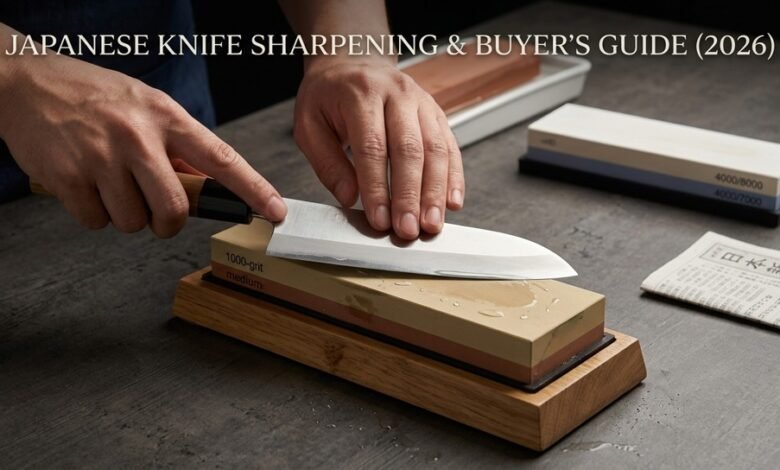
Your Japanese knife arrived razor-sharp. Three months later, it feels like it’s fighting the onion instead of cutting through it. That’s not a defect it’s a maintenance gap. Japanese knives require a different sharpening approach than their Western counterparts, and a pull-through sharpener or honing steel won’t do the job. What they need is a whetstone.
This step-by-step guide covers choosing the right stone, setting the correct angle, and working through the grit progression so your blade comes off the stone sharper than when it arrived.
Why Japanese Knives Need Whetstone Sharpening
Japanese knives are forged from harder steel than most Western blades typically 60 HRC and above on the Rockwell scale. That hardness enables the thin, acute edge that makes them precise. It also makes them incompatible with honing steels, which are designed for softer European steel and can chip or roll a Japanese edge rather than realign it.
Pull-through sharpeners grind at a fixed angle that rarely matches Japanese blade geometry, and they remove more metal than necessary. A whetstone lets you sharpen at the correct angle, control the pressure, and work from coarse to fine grit removing only what’s needed and leaving a clean, consistent bevel.
Understanding Whetstone Grits
Whetstones are categorized by grit number the lower the number, the coarser the abrasive and the more material it removes. Here’s how the progression works in practice:
- 220–400 grit (coarse): For reprofiling a badly damaged edge or correcting a chipped bevel. Not needed in routine maintenance.
- 1000 grit (medium): The standard starting point for regular sharpening. Efficiently rebuilds the edge bevel.
- 3000 grit (medium-fine): Refines the edge after the 1000-grit stage, removing the scratch pattern and starting the polish.
- 6000 grit and above (fine): Polishes the edge to a refined finish. Particularly effective on carbon steel blades.
For most home cooks, a two-stone setup handles everything: 1000-grit to sharpen, 3000 or 6000-grit to finish.
Choosing the Right Whetstone
Soaking vs. Splash-and-Go
Traditional water stones require soaking for 5–10 minutes before use. Splash-and-go stones only need a light surface wetting and are immediately ready. Both perform well; the difference is convenience. For regular sharpeners, splash-and-go stones save time without sacrificing results.
Stone Materials
Japanese synthetic whetstones made from aluminum oxide or silicon carbide offer consistent cutting speed and predictable wear. Natural Japanese finishing stones produce an exceptional polish on carbon steel but vary in grit and are best suited to experienced sharpeners.
A curated selection of Japanese whetstones organized by grit and style makes it easy to build the right setup, whether you’re starting out or refining an existing kit.
Step-by-Step: Sharpening a Japanese Knife on a Whetstone
Step 1 — Set Up Your Stone
Place the whetstone on a damp cloth or a dedicated holder to prevent it from sliding. Soak if required, or wet the surface lightly. Keep water nearby to refresh the stone during sharpening.
Step 2 — Find Your Angle
Japanese knives sharpen at 10–15 degrees per side lower than Western knives. A practical guide: lay the blade flat on the stone, then raise the spine until a business card slides underneath with light resistance. That’s approximately 10–12 degrees. Hold this angle consistently on every stroke it’s the single most important variable in the process.
Step 3 — Sharpen on the 1000-Grit Stone
Rest two fingers on the flat of the blade near the edge. With moderate, even pressure, push the blade forward along the stone edge leading in a smooth arc from heel to tip. After every five to eight strokes, flip the blade and repeat on the other side. Continue until you feel a slight burr forming along the edge a thin ridge of metal that confirms you’ve reached the bevel apex.
Step 4 — Refine on the Finishing Stone
Switch to your 3000 or 6000-grit stone. Use lighter pressure and alternate sides every two to three strokes. This removes the burr and polishes out the scratch pattern left by the coarser stage. Finish with two or three alternating single strokes per side at minimal pressure.
Step 5 — Test the Edge
Draw the blade across a sheet of printer paper held vertically. A sharp edge produces a clean, uninterrupted slice. Tearing or dragging means another pass on the finishing stone. A properly sharpened Japanese knife will also slice through the skin of a ripe tomato with zero applied pressure.
Maintenance Between Sharpening Sessions
For daily use, a 1000-grit session every four to six weeks, followed by a finishing pass, keeps most blades performing well. Three habits extend the time between sessions: use only wooden or soft-plastic cutting boards, hand-wash and dry after every use, and store the knife on a magnetic rack or in a sheath rather than leaving it loose in a drawer.
These habits apply across the full range of Japanese kitchen knives from everyday all-purpose blades to specialist formats. Consistent care is what separates a knife that performs for a decade from one that dulls in months.
A Skill Worth Building
The first whetstone session takes patience. The angle feels unfamiliar, and the burr is hard to detect. By the third session, muscle memory takes over. By the fifth, the process is methodical and the edge you produce is sharper than anything a pull-through service tool delivers.
Sharpening is a deeper engagement with your blade: its geometry, its steel, what a truly sharp edge actually feels like. Once you’ve done it properly, it becomes one of the most satisfying skills in the kitchen.
Where are you in your sharpening journey still working up the nerve to try a whetstone for the first time, or already hooked on the process? Share your experience below.