

There is a quiet shift happening in how Indian financial entities are being judged on software risk. It is less about intent and more about evidence. Less about policies and more about artefacts you can put on the table when asked.
The SEBI CSCRF SBOM checklist sits right in the middle of that shift.
Securities and Exchange Board of India has not framed this as a technical exercise. It is a governance expectation. If your organisation builds, buys or operates software that touches regulated activity, you are expected to know what is inside it. Not roughly. Precisely.
An SBOM is simply the format they have chosen to enforce that clarity.
What follows is not a restatement of the framework. It is a practitioner’s reading of what those nine fields actually mean in operational terms, and where most institutions stumble.
Why SBOMs Suddenly Matter Under CSCRF
For years, third party risk in financial services was handled through questionnaires and contractual assurances. Those tools have not aged well. Supply chain attacks made that obvious long before regulation caught up.
CSCRF does not say “implement an SBOM because it is modern”. It says you must be able to identify, assess and respond to software risk across your ecosystem. The SBOM is the evidence trail that makes that possible.
If you cannot produce one that is current, complete and defensible, your vulnerability management story collapses very quickly under scrutiny.
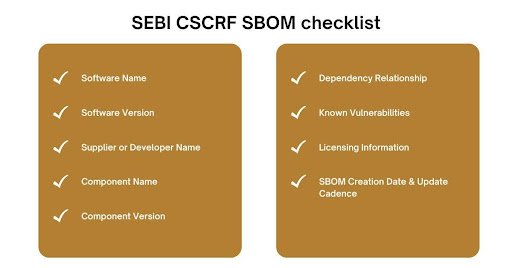
The Nine Mandatory SBOM Fields SEBI Expects to See Below are the nine mandatory fields that SEBI expects to see in your SBOM:
- Software Name
This sounds trivial until you realise how many internal applications have three different names depending on who you ask. SEBI expects a single, unambiguous identifier. No aliases. No internal nicknames. - Software Version
Version drift is one of the most common blind spots. The SBOM must reflect what is actually running in production, not what procurement thinks was purchased. - Supplier or Developer Name
This includes in-house development units and external vendors. If a component came from a marketplace, a contractor or an acquired product, that lineage matters. - Component Name
Every library, module and package that materially contributes to the software must be listed. This is where open-source sprawl becomes visible, often uncomfortably so. - Component Version
Listing a component without its exact version is effectively useless for risk analysis. Vulnerabilities are version specific. SEBI knows this. - Dependency Relationship
Direct and transitive dependencies must be clear. It is not enough to know a vulnerable library exists. You need to know how it enters your environment. - Known Vulnerabilities
This is not a static field. It changes as new CVEs are published. An SBOM that is generated once a year fails the spirit of CSCRF entirely. - Licensing Information
Licensing risk is still underestimated in financial services. SEBI has deliberately included this to force legal and technology teams into the same conversation. - SBOM Creation Date & Update Cadence
This field tells the regulator whether the SBOM is a living control or a compliance artefact. They can tell the difference very quickly.
Where Financial Entities Usually Get Stuck
The failure mode is rarely technical capability. Most large institutions can generate SBOMs. The issue is ownership.
1.Lack of Clear Ownership and Accountability
In many environments, SBOMs exist in a grey zone of responsibility. Security teams often generate them as part of compliance initiatives. Development teams view them as an external compliance artifact rather than a living engineering input. Risk and compliance teams reference them during audits or assessments but often do not fully understand what gaps or exposures remain. Over time, this fragmented ownership leads to stale SBOMs, inconsistent updates and a false sense of assurance that “someone else” is maintaining accuracy.
2.SBOMs Treated as Static Artifacts Instead of Governance Controls
CSCRF implicitly shifts SBOMs from being a DevSecOps output to becoming a formal governance control. This means SBOMs must have defined ownership, version tracking and audit visibility. Without these governance mechanisms, SBOMs lose relevance and fail to support risk decisions, regulatory reporting or incident response when supply chain vulnerabilities emerge.
3.Disconnect Between Technical Data and Risk Interpretation
Even when SBOMs are technically accurate, many institutions struggle to translate them into actionable risk insights. Risk teams may not have the context to assess the real business impact of vulnerable parts, while engineering teams may not prioritize solutions unless clear risk thresholds are established. This communication gap weakens the value of SBOMs as a decision-making tool rather than just a compliance checkbox.
4.Narrow or Selective Scope Definition
Organizations often begin SBOM initiatives with customer-facing applications and quietly exclude internal platforms, batch processing systems and legacy tools. While this may reduce initial effort, it creates blind spots in operational resilience and third-party risk exposure. SEBI’s language does not support selective scoping and regulators expect broad visibility across the entire application landscape, not just externally visible systems.
5.Sustainability and Operational Fatigue
Initial SBOM rollouts often receive strong executive sponsorship, but ongoing maintenance can suffer once the project phase ends. Without automation, ownership clarity and embedded workflows, teams struggle to keep SBOMs current at scale, leading to gradual degradation of data quality and trust.
SBOMs as a Regulatory Signal, not a Checklist Item
It is tempting to treat the SBOM requirement as another box to tick. That approach rarely survives its first serious review.
A well maintained SBOM tells a regulator three things without a single extra slide deck.
- You understand your software supply chain.
- You can respond quickly when something breaks.
- And you are not guessing when you talk about cyber risk.
Those signals matter far more than the document itself.
Conclusion
CSCRF has changed the tone of cyber compliance in Indian financial services. The SBOM requirement is one of the clearest examples. It forces uncomfortable visibility, but it also gives organisations a chance to replace assumptions with evidence.
For teams that are struggling to operationalise this, CyberNX can help. They provide an in-house built tool which enables end-to-end automation from collection to analysis and ensures complete visibility into software components. More importantly, they help turn SBOMs into something that stays current rather than something created once for an audit and forgotten.
Handled properly, the SBOM becomes less of a regulatory burden and more of a stabilising control. That is the outcome SEBI is pushing towards, whether it is stated explicitly or not.