

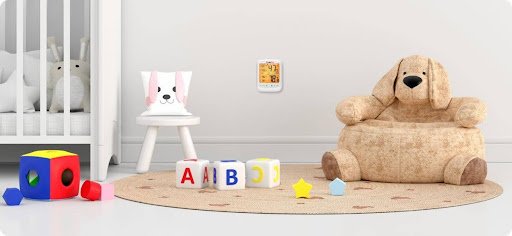
You put your baby down for a nap, tip-toe out of the nursery, and collapse onto the sofa. Maybe you finally sit down with a warm cup of coffee that has gone cold twice already. But then the worry creeps in. Is the room too warm? Should I turn on the air conditioner? Is my baby too cold? Do I need to go check again?
If you are a new mom, you have probably had this exact thought more times than you can count. The anxiety is real, and it is exhausting. One of the biggest concerns new parents face is whether their baby’s sleep environment is safe and comfortable. A room that is too hot or too dry is not just about comfort. It can actually pose health risks. But here is the good news. You do not have to guess. With the right information and the right tools, you can create the perfect nursery environment that gives you peace of mind and gives your baby safe, restful sleep.
This guide will walk you through everything you need to know about ideal nursery temperature and humidity levels. We will cover why these factors matter so much, what the experts recommend, and how a digital hygrometer thermometer can take all the guesswork out of keeping your baby safe and comfortable.
Why Temperature and Humidity Matter for Your Baby
Newborns are not simply miniature adults. Their bodies function very differently, especially when it comes to temperature regulation. Babies have immature thermoregulatory systems. They cannot control their body temperature as effectively as older children and adults can. Their sweat glands are not fully developed. Their body surface area is large relative to their weight, which makes them lose heat quickly. And they do not have enough body fat to keep themselves warm.
At the same time, overheating is a well-documented risk factor for Sudden Infant Death Syndrome (SIDS). The American Academy of Pediatrics specifically lists overheating as a danger to be avoided in safe sleep recommendations. Clinical evidence demonstrates that cooler environments significantly reduce SIDS risk because infants maintain their biological arousal response far better than in heavily heated nurseries. Overheating can blunt a baby’s arousal response, which is the body’s natural ability to wake up when experiencing a drop in oxygen or other distress.
Indoor temperature is not the only factor that affects your baby’s comfort and health. Humidity, or the amount of moisture in the air, plays an equally important role. Low humidity can lead to dry nasal passages, which makes it harder for your baby to breathe comfortably. It can also cause dry, irritated skin and worsen conditions like eczema. Dry air can make congestion worse, interfering with sleep and feeding. High humidity, on the other hand, encourages the growth of mold, dust mites, and other allergens, which can trigger respiratory issues and allergic reactions. Maintaining the correct balance is essential for protecting your baby’s delicate respiratory system and skin.
The Perfect Nursery Environment: What the Experts Say
So, what exactly should you aim for when setting up your baby’s room? The recommendations come directly from leading health authorities and pediatric experts. These are not just nice-to-have suggestions. These are science-backed guidelines designed to keep your baby safe.
Temperature Guidelines
The ideal nursery temperature is 68°F to 72°F (20°C to 22°C). This is the range recommended by the American Academy of Pediatrics and is supported by a wide range of clinical evidence. Babies sleep best in rooms kept between 68°F and 72°F. This range helps prevent dangerous overheating while still keeping your little one comfortable. Some experts note that beyond 72°F, there is an increased risk of mold proliferation and the presence of dust mites, which are responsible for many allergies.
It is worth noting that this temperature range is meant for a lightly clothed baby. The AAP advises that babies should be dressed appropriately for the sleep environment, with no more layers than an adult would comfortably wear. Avoid covering the baby’s face or head. A good rule of thumb is that if the room is comfortable for a lightly clothed adult, it is likely comfortable for your baby. Remember, you should never rely on your baby’s hands or feet to gauge their temperature. Due to immature circulation, infants often have cool hands and feet even when their core body temperature is perfectly normal. This condition is called acrocyanosis, and it is completely normal.
Signs that your baby might be too hot include sweating, damp hair, flushed cheeks, a heat rash, and rapid breathing. If you notice any of these signs, remove a layer of clothing or lower the room temperature immediately.
Humidity Guidelines
When it comes to moisture in the air, the ideal relative humidity for a nursery is 40% to 60%. This range is widely recommended by pediatric experts and environmental health organizations. Maintaining humidity within this range helps prevent respiratory issues, keeps your baby’s skin from becoming dry and irritated, and creates a comfortable environment for restful sleep.
During winter months, indoor heating can dry out the air significantly, often dropping humidity below 30%. In summer, air conditioning can also reduce moisture levels. Conversely, in humid climates without proper dehumidification, humidity can climb well above 60%, creating ideal conditions for mold and dust mites.
Why the Thermostat on Your Wall Is Not Enough
Many new parents assume that setting their home’s central thermostat to the correct temperature is sufficient. Unfortunately, this is rarely the case. Thermostats measure the temperature at a single location, typically in a hallway or living room. The temperature in your baby’s nursery could be significantly different due to a variety of factors.
Drafty windows can let in cold air during winter. Rooms on the second floor often become warmer in summer because heat rises. Rooms located far from the HVAC system may not receive adequate airflow. The position of your baby’s crib relative to heating vents, radiators, or air conditioning units can create hot or cold spots. Simply put, the number on your wall thermostat may have very little relationship to the actual temperature at your baby’s eye level in the crib.
Additionally, humidity levels cannot be detected by a standard thermostat at all. You might be completely unaware that the air in the nursery is too dry until your baby develops dry skin, chapped lips, or persistent nasal congestion. The only way to truly know the conditions in your baby’s room is to measure them directly, right where your baby sleeps.
This is where a dedicated indoor temperature and humidity monitor becomes indispensable. A high-quality wireless hygrometer thermometer allows you to track the exact temperature and humidity levels in your baby’s nursery in real time. You no longer have to rely on guesswork or run back and forth to check the room. You simply place the device in the nursery, and it does the rest.
What Wireless Hygrometer Thermometer Is Great for Nursery
The TempPro TP359 Bluetooth Hygrometer Thermometer is specifically designed for parents who want to create the safest, most comfortable environment for their baby. This smart device removes all the guesswork from nursery climate control and gives you complete visibility into your baby’s surroundings from the palm of your hand. Here is why this device has become a favorite among new moms.
260-Foot Bluetooth Range with Advanced Bluetooth 5.0
The TempPro TP359 features an impressive 260-foot wireless range via Bluetooth 5.0. This means you can place the device in your baby’s nursery and monitor temperature and humidity readings from anywhere in your home. Whether you are in the kitchen preparing dinner, in the living room watching TV, or even in your backyard, the data comes straight to your smartphone. You never have to tip-toe into the nursery and risk waking your baby just to check the room temperature. This long-range capability is particularly valuable in larger homes where the nursery might be located far from where you spend most of your time.
Instant App Alerts for Complete Peace of Mind
One of the most valuable features of the TempPro TP359 is its smart alert system. When you download the app and set up your device, you can configure custom temperature and humidity limits. If the temperature in the nursery rises above your set maximum, the app instantly pushes an alert to your smartphone. The same thing happens if the temperature drops too low, if humidity falls below 40%, or if humidity exceeds 60%. You receive these alerts in real time, allowing you to adjust your thermostat, humidifier, or dehumidifier immediately. There is no delay. You do not have to constantly stare at the app. The TempPro TP359 quietly works in the background, notifying you only when your attention is needed.
High Precision Accuracy for Reliable Readings
Accuracy is essential when you are making decisions that affect your baby’s safety and comfort. The TempPro TP359 is built with a high-precision NTC sensor that delivers exceptional accuracy of ±0.9°F for temperature and ±2% for relative humidity. It updates its readings every 10 seconds, providing you with real-time insights into even the smallest changes in the nursery environment. You can trust that the numbers you see are reliable, not just rough estimates.
Large Backlit LCD Display for at-a-Glance Readings
While the app provides remote monitoring, the TempPro TP359 also features a large 3.5-inch backlit LCD screen that is easy to read even from across the room. The backlit display features a convenient touch button, allowing you to read the temperature and humidity even in dark conditions. This is perfect for those middle-of-the-night checks when you do not want to turn on bright lights and disturb your sleeping baby. You can simply glance at the device’s screen while standing at the nursery door.
Data Storage and Historical Graphing
The TempPro TP359 does more than just show you current conditions. It also records temperature and humidity data within the app, providing dynamic charts that help you understand trends over time. You can view data from the last 24 hours, one week, one month, or even up to one year. This historical data allows you to see patterns. For example, you might notice that your baby’s room consistently gets warmer in the late afternoon, allowing you to adjust your window coverings or HVAC settings proactively. You can also identify how the nursery responds to different weather conditions outside, giving you full control over your baby’s environment.
Optional 2-Year Data Export
For parents who want even deeper insights, the TempPro TP359 also supports up to two years of data storage and export. This feature allows you to download all of your historical temperature and humidity data for analysis. It is particularly useful if you are trying to troubleshoot chronic issues such as persistent dry skin, frequent congestion, or mold concerns. The data export capability empowers you to make informed, data-driven decisions about your nursery’s climate control.
Simple Setup and User-Friendly App
One of the biggest worries new parents have is that technology will be too complicated to figure out when they are already exhausted and overwhelmed. The TempPro TP359 is intentionally designed to be simple. The setup process takes only a few minutes. You download the app, insert the included AAA batteries into the device, and pair it with your phone via Bluetooth. The app interface is clean, intuitive, and designed for people who want information without unnecessary complexity. Many parents have praised how quickly and easily the TempPro TP359 connects and how reliable the Bluetooth connection remains.
Multiple Placement Options
The TempPro TP359 is compact and lightweight, designed to fit seamlessly into any nursery. It can be placed on a tabletop, shelf, or dresser. The device features a built-in magnetic back, which allows you to attach it securely to a metal surface such as a crib frame, a lamp base, or an air conditioning vent. This versatility ensures you can position the device exactly where you need it, at a safe distance from the crib but close enough to accurately reflect the conditions your baby is experiencing.
Why the TempPro TP359 Is Perfect for New Moms
New motherhood is filled with countless worries. You worry about feeding, diapering, soothing, and sleeping. You worry about every cry and every unusual sound. The last thing you need is to lie awake at night wondering if your baby’s room is too hot or too cold. The TempPro TP359 eliminates that specific worry entirely.
With the TempPro TP359, you gain the ability to:
- Check the nursery’s temperature and humidity instantly from your phone, without opening the door.
- Receive immediate alerts when conditions become unsafe, before they affect your baby’s comfort or health.
- Track historical data to understand how the nursery responds to different times of day and different weather conditions.
- Make confident adjustments to your humidifier, dehumidifier, or thermostat based on accurate, real-time readings.
- Sleep better at night knowing that you have complete visibility into your baby’s environment.
Moms who use the TempPro TP359 consistently report that it gives them true peace of mind. They no longer second-guess themselves. They no longer get up ten times a night to feel the room’s temperature. They trust the data, and the data gives them the confidence to rest.
Practical Tips for Maintaining the Perfect Nursery Environment
Armed with a reliable monitor like the TempPro TP359, you can take practical steps to keep the nursery in the ideal range year-round.
Check the temperature and humidity at the crib level. The TempPro TP359 should be placed near the crib, but safely out of your baby’s reach. It should not be placed directly on windowsills, above heating vents, or in direct sunlight, as these locations can produce inaccurate readings.
Adjust your thermostat based on the TempPro TP359 readings. Set your home’s HVAC system to maintain the nursery’s target temperature, not the other way around. If your home has zones, set the nursery zone separately.
Use a cool-mist humidifier in winter. When indoor heating dries out the air, a cool-mist humidifier can add necessary moisture to keep the nursery within the 40% to 60% target range. The TempPro TP359 will tell you exactly when the humidity has reached the desired level.
Use a dehumidifier in humid climates or seasons. In summer or in naturally humid regions, a dehumidifier can help keep the nursery from becoming too damp, which prevents mold growth and dust mite proliferation.
Dress your baby appropriately. Use lightweight, breathable sleepwear. A general guideline is to dress your baby in one more layer than you would comfortably wear. Avoid hats or head coverings during sleep as these can contribute to overheating. A wearable blanket or sleep sack is a safer alternative to loose blankets, which the AAP advises against using in the crib.
Keep the crib away from windows, vents, and radiators. Proper crib placement helps minimize the impact of drafts, direct heat, or cold spots. A temperature reading from the TempPro TP359 will help you identify problematic areas.
Ventilate the room daily. Even during winter, opening a window for a few minutes each day can help refresh the air and regulate humidity levels. Just make sure to move your baby to another room while you do this.
When to Seek Medical Attention
While the TP359 is an excellent tool for preventing temperature-related discomfort, it is important to recognize when your baby needs medical attention. If your baby’s room has been consistently within the recommended 68°F to 72°F range and 40% to 60% humidity, but your baby still shows signs of distress, consult your pediatrician. Do not rely solely on room conditions to determine your baby’s health. Signs that warrant medical attention include persistent fever, difficulty breathing, unusual lethargy, or refusal to feed.
Conclusion
You do not need to spend another sleepless night worrying about whether your baby’s room is too hot, too cold, too dry, or too humid. The ideal nursery temperature is 68°F to 72°F, and the ideal relative humidity is 40% to 60%. Achieving and maintaining these conditions does not have to be complicated or stressful.
With the TempPro TP359 Indoor Bluetooth Hygrometer Thermometer, you can monitor your baby’s environment with precision and confidence. The 260-foot Bluetooth range, instant app alerts, high accuracy, large backlit display, and comprehensive data logging make this device an essential tool for any new parent. You can finally stop guessing and start knowing. You can rest easier because you will see, right on your phone, that your baby is sleeping in a safe and comfortable environment.