
AI & EHR Integration: How Ambient AI Documentation Is Changing Clinical Workflows

One of the main reasons for clinician burnout is documentation, or more specifically, extra time spent on switching between EHR screens. Moreover, this also leads clinicians to spend more time on EHR rather than listening to what patients are saying during the encounter, creating incomplete patient records.
But why does this happen?
Well, when EHRs are built, either they are not aligned with clinics’ workflows or don’t have the needed document layout as per specialties. This means that when a clinician tries to record patient details, he doesn’t find what he is looking for at the right time.
However, this problem can be solved if you have a clinical workflow EHR integration with ambient AI. When you integrate ambient AI in healthcare, documenting the session becomes much easier and more accurate.
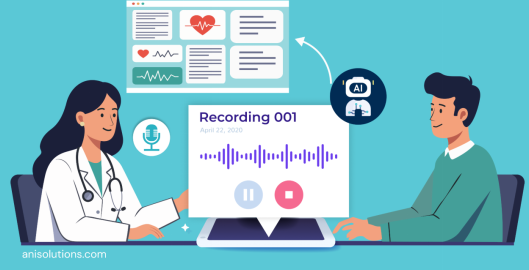
Because you no longer need to type the patient details, as they are captured automatically in the background without disrupting the flow of the patient encounter. Moreover, the AI automatically transcribes it into SOAP notes, keeping notes structured.
But these are not the only how ambient AI improves clinical workflows, and in this blog, we will see more benefits of AI and EHR integration in healthcare and how you can leverage them for your healthcare organization.
Ambient AI in Clinical Workflows: Promise vs Reality
The ambient AI is not a new technology, as you may know, and many systems have adopted it for its benefits. But before diving into the details, let’s first understand how ambient AI works in brief.
Firstly, it is a tool that captures the voice and records the conversation in the background while you talk with patients. The tool is trained on clinical terms such as LOINC, SNOMED CT, and ICD-10 codes for more precise and meaningful recordings.
The biggest difference it brings when implemented is shifting the documentation from after-visit to real-time. Meaning, clinicians don’t have to work overtime to just reconcile patient details, as the AI captures patient details and creates documentation instantly after the visit.
However, if the tool is not integrated into the EHR, then the clinicians still have to do the edits manually and update the patient details themselves. Although this takes much less time than doing it completely from capturing patient details to updating them manully it still takes up an extra five minutes.
That’s why, if you want to make the real-time documentation a reality rather than just a benefit, then integration with EHR is the best option. Let’s understand how these EHR integration solutions transform clinical documentation.
How EHR Integration Enables Real Workflow Transformation?
As I said above, the ambient AI can’t show its full potential until it is integrated into your EHR. When you connect an AI clinical documentation tool with EHR, the need for updating patient profiles after each encounter is completely eliminated.
The job of your clinicians shifts from entering patient data to reviewing what the ambient AI has updated, which takes very little time. Moreover, sometimes, clinicians just copy-paste patient details to save time, which may create duplicate entries in patient records, increasing patient safety risks.
However, by integrating ambient AI, this duplication is eliminated as the patient data is completely captured and direclty updates in the right patient profiles. This helps in creating complete and accurate patient records while saving time for clinicians at the same time.
Most importantly, the documentation is structured automatically with the right format for clinical documentation. It is synchronized with patient records and made available almost instantly in existing systems for clinicians to use.
In short, when ambient AI is connected with EHR, it becomes a virtual assistant always present to take notes. Whereas, if used as a standalone tool, it acts only as a notepad, nothing more.
What Changes in Day-to-Day Clinical Workflows
When you implement clinical workflow EHR integration with ambient AI, the biggest shift happens in how clinicians spend their time during and after patient visits.
Firstly, documentation becomes a real-time activity rather than a post-visit burden. Instead of recalling details later, clinicians get structured notes instantly, which improves both accuracy and efficiency.
This directly reduces “pajama time,” where clinicians spend hours after work completing charts. Since AI clinical documentation happens in the background, the administrative workload drops significantly.
Another important shift is the role of physicians. They are no longer acting as data entry operators. Instead, they review, validate, and finalize AI-generated notes, which takes far less effort.
Most importantly, clinicians can focus more on patient interaction. With fewer distractions from screens and typing, they can actually listen better, leading to more meaningful and complete patient encounters.
Operational & Financial Impact of Integrated Workflows
Beyond clinical efficiency, EHR integration solutions combined with ambient AI also create strong operational and financial outcomes.
Firstly, patient throughput increases. Since documentation is no longer a bottleneck, clinicians can handle more patients without extending their working hours.
Secondly, coding accuracy improves. Because AI captures structured and complete documentation, it supports better coding, which leads to improved revenue capture.
At the same time, claim errors reduce significantly. Missing or inconsistent documentation is one of the main reasons for denials, and ambient AI helps eliminate these gaps.
Additionally, administrative costs go down as manual work is reduced across documentation, billing, and review processes.
Finally, better workflows lead to better staff retention. When clinicians experience less burnout and more efficiency, they are more likely to stay, making this not just a technology upgrade but a workforce strategy.
Challenges in Integrating AI into Clinical Workflow
While the benefits of AI and EHR integration in healthcare are clear, there are still challenges that organizations need to address.
One of the biggest issues is integration with legacy EHR systems. Many systems are not designed for modern AI capabilities, making implementation complex and time-consuming.
Another concern is data accuracy and clinician trust. Even though ambient AI is highly advanced, clinicians still need confidence that the documentation is reliable before fully depending on it.
Compliance is also critical. Since ambient AI deals with sensitive patient conversations, ensuring HIPAA-compliant data handling and security is non-negotiable.
Lastly, variability across healthcare environments makes standardization difficult. Different specialties, workflows, and documentation styles require flexible solutions rather than a one-size-fits-all approach.
Conclusion: From AI Tools to Workflow Transformation
Ambient AI is powerful, but its real value does not come from the tool itself. It comes from how well it is integrated into your workflows.
Without clinical workflow EHR integration, ambient AI remains just another documentation tool. But when properly integrated, it transforms how care is delivered, documented, and managed.
The real shift is not from manual to automated documentation, but from fragmented workflows to connected, intelligent systems.
And as healthcare continues to evolve, organizations that prioritize integration over isolated adoption will be the ones leading in both efficiency and care quality.
Because in the end, it’s not about adding AI—it’s about redesigning workflows around it. So, if you want to keep pace with the evolving landscape, then it’s time to adapt to AI. Talk to our subject matter experts right away for your system readiness assessment.
Frequently Asked Questions
- What is ambient AI documentation in healthcare?
Ambient AI documentation in healthcare refers to AI tools that capture patient–clinician conversations in real time and automatically convert them into structured clinical notes. These systems work in the background, reducing manual data entry while ensuring accurate, complete, and standardized documentation within the EHR.
- How does clinical workflow EHR integration improve efficiency?
Clinical workflow EHR integration improves efficiency by eliminating duplicate data entry and automating documentation updates directly within patient records. It aligns workflows with how clinicians actually work, reducing time spent switching systems and enabling faster, more accurate access to patient information during care delivery.
- How does ambient AI reduce physician burnout?
Ambient AI reduces physician burnout by minimizing time spent on manual documentation and after-hours charting. It captures and structures clinical notes automatically, allowing physicians to focus more on patient care instead of administrative tasks, ultimately reducing cognitive load and improving work-life balance.
- How does AI integrate with EHR systems in real time?
AI integrates with EHR systems in real time through APIs and interoperability standards like FHIR. It captures clinical conversations, processes them instantly, and updates structured data directly into patient records, ensuring that documentation is available immediately without requiring manual input from clinicians.
- What are the benefits of AI-driven clinical documentation?
AI-driven clinical documentation improves accuracy, reduces administrative workload, and ensures consistent, structured records. It enhances coding quality, supports better clinical decision-making, and saves time by automating note creation, allowing healthcare providers to focus more on patient interaction and care delivery.
- Is ambient AI documentation secure and HIPAA compliant?
Yes, ambient AI documentation can be secure and HIPAA compliant when implemented correctly. It uses encrypted data transmission, secure storage, and access controls to protect patient information. Compliance depends on the vendor’s adherence to regulatory standards and proper integration within secure healthcare IT environments.
- What challenges do hospitals face when implementing AI in workflows?
Hospitals face challenges such as integrating AI with legacy EHR systems, ensuring data accuracy, gaining clinician trust, and maintaining regulatory compliance. Additionally, variations in workflows across departments make implementation complex, requiring customization and careful change management to ensure successful adoption.
- How can healthcare providers choose the right AI integration solution?
Healthcare providers should choose AI integration solutions that align with their workflows, support interoperability standards like FHIR, and integrate seamlessly with existing EHR systems. Evaluating vendor compliance, scalability, accuracy, and ease of use is essential to ensure long-term efficiency and adoption.