

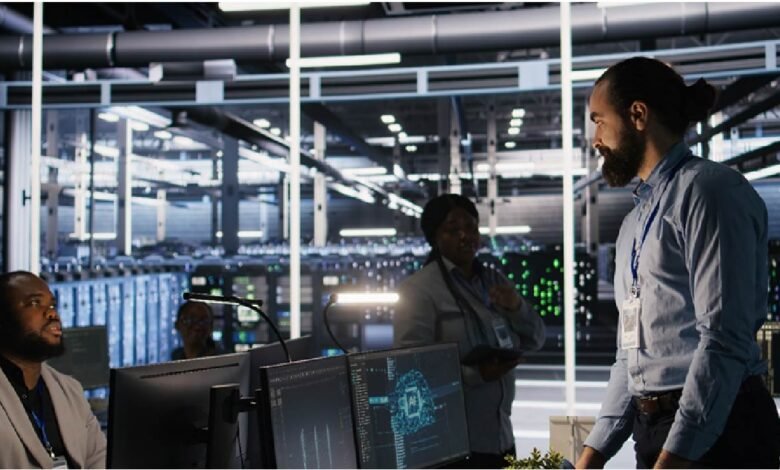
Data Centers are an integral part of the global tech infrastructure as they support everything from cloud-native applications to compute-heavy workloads. The shift towards virtualization, cloud computing, and artificial intelligence is not just a tech trend; instead, it has become a necessity. It is now mandatory for businesses to innovate their facilities to remain competitive in the advanced digital landscape.
Whether you are ready to deploy hybrid cloud services or scale your enterprise’s IT infrastructure, the right server is necessary to provide seamless performance and resilience. Over the years, it has become evident that businesses that align their server infrastructure with the growing needs of their applications have continued to provide reliable and high-performance services.
What Is Server Technology in Data Centers?
In data centers, server technology refers to the physical and virtual hardware and software components that perform the core functions of storing, processing, and managing data. These servers are deployed in large volumes in data centers to support business-critical operations.
They manage intensive tasks like web hosting, database management, processing data requests, and performing complex calculations. They also facilitate communication and data transfer within the data center and to external networks.
Why Are Servers Important in Data Centers?
Servers are crucial in a data center, as they handle core hardware that performs computing tasks, stores data, and manages network traffic. They serve as the backbone of data centers, enabling the delivery of services such as cloud computing, web hosting, and data storage.
Significant advancements in server technology require more scalable and high-performance computing solutions. Let’s explore the latest trends in server technology that necessitate innovation in data center IT infrastructure.
AI-driven Data Center Operations:
Artificial Intelligence emerges as a game-changer, significantly impacting data center efficiency. AI programs optimize performance through predictive analytics, identifying concerns and connecting them with energy usage and processes. It reduces unexpected server outages by scheduling timely maintenance. Moreover, it extends the lifespan of the server’s components (disks, CPUs, and fans, etc.). AI also automates workload distribution across
Server Virtualization:
Server virtualization is one of the trends in server technology that has revolutionized data center operations. Virtualization allows multiple virtual machines to run on a single physical server. It results in potential optimization of resource utilization and a reduction in hardware costs.
It offers improved access to resources and increased flexibility. Owing to the benefits, many Managed Service Providers (MSPs) are inclined towards Software-Defined Data Centers (SDDCs). In SDDCs, virtualization technologies recreate computing and storage in software form.
Key benefits of server virtualization:
- Better resource utilization and reduced hardware costs
- Increased flexibility and scalability
- Faster deployment of applications and services
- Improved access to computing resources
- Enhanced disaster recovery and backup capabilities
- Foundation for Software-Defined Data Centers (SDDCs)
Edge Computing Integration:
With the growth of IoT, 5G, and artificial intelligence, businesses are now transitioning to edge computing. In this model, data processing, storage, and computation are moved closer to the data source, rather than relying on a central cloud and data center. It minimizes the latency and bandwidth usage by processing data at the “edge” of the network.
The core principle of edge computing is to bring computation closer to where the data is generated.
Liquid Cooling and Sustainable Thermal Management:
High-performance computing, GPUs, and AI generate enormous heat. With the increasing density of servers, cooling remains a significant challenge. To combat this challenge, liquid cooling emerges as an efficient alternative to traditional air cooling. It provides better temperature control, reduces energy consumption in data centers, and supports a denser compute environment.
Adoption of ARM-Based and Energy-Efficient Servers:
ARM-based servers are known for their energy efficiency and high performance. They are becoming more desirable for data centers and cloud providers as they consume less power than traditional x86 chips. It reduces operational costs in power-hungry data centers. They are highly efficient for cloud-native applications, AI inference tasks, edge computing, and storage workloads.
NVMe Over Fabrics (NVMe-oF) and Next-Gen Storage:
NVMe-oF (Non-Volatile Memory Express over Fabrics) is an extension of the NVMe protocol that is designed to work over network fabrics (like Ethernet, Fibre Channel, or InfiniBand). It also enables high-speed, low-latency access to remote storage, similar to accessing local NVMe drives, being combined with next-gen hardware.
PCIe 5.0/6.0 and high-density ssd storage, powers the next wave of high-performance, efficient, and flexible data center infrastructure.
Next-gen storage include:
- Ultra-low latency data access comparable to local storage
- High throughput for data-intensive and real-time applications
- Scalable architecture for growing data center demands
- Improved storage efficiency and resource utilization
- Faster data transfer across distributed environments
- Ideal for AI, machine learning, and big data workloads
- Seamless integration with modern cloud and hybrid infrastructures
Software-Defined Infrastructure (SDI) &Hyperconvergence:
Software-defined infrastructure enables management through software while offering greater flexibility. It integrates computing, storage, and networking into a single, software-driven solution with centralized management. They mitigate the traditional hardware limitations and simplify management.
Moreover, it reduces costs and enables enterprises to build resilient and future-ready infrastructure. This transformation is pivotal for businesses that embrace digital transformation, hybrid cloud, and next-gen workloads. Hyperconverged Infrastructure integrates compute, storage, and networking into a single, software-driven solution with centralized management.
Quantum-Safe and Enhanced Cybersecurity Measures:
Cybersecurity is a profound concern for IT enterprises. Data centers are slowly adopting quantum computers, which break traditional encryption algorithms (RSA, ECC). They are also adopting quantum-safe cryptography to protect data against future quantum threats.
This trend in data centers is a proactive measure against any kind of cyberattack, preventing your data from any type of breach.
Server Disaggregation and Composable Infrastructure:
Server disaggregation breaks down conventional servers into modular, independent components, including compute, storage, memory, and networking. Composable infrastructure is a concept where computing, storage, and networking resources are decoupled from their physical locations and treated as services that can be dynamically pooled and allocated based on application needs.
Conclusion:
With these trends in server technology, data centers are transitioning from rigid, hardware-centric infrastructures to agile, software-defined ecosystems. These advancements not only improve scalability, flexibility, and performance but also drive sustainability, cost savings, and security.
The advanced data centers are becoming more intelligent, greener, and more resilient due to the support of AI, cloud, edge computing, and virtualization.
FAQs:
- What are the key server trends in 2025?
AI-powered automation, edge computing, and energy-efficient hardware are the biggest server trends transforming modern data centers.
- How is AI improving data center performance?
AI helps optimize workloads, predict failures, and automate resource management, making data centers faster and more efficient.
- Why is edge computing important for servers?
Edge computing reduces latency by processing data closer to users, improving speed and performance for real-time applications.