

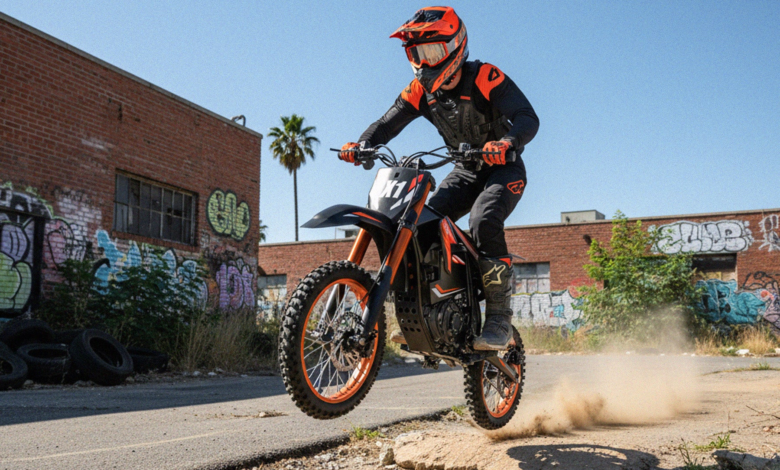
Electric dirt bikes spark strong opinions. Some riders assume they are easier, softer, or built mainly for beginners. Others worry they are too abrupt, too limited by battery, or too different from what they are used to. Most of these conclusions form before someone has spent meaningful time in the saddle. The biggest misconceptions are not about numbers on a spec sheet. They come from applying old expectations to a new riding experience.
Understanding electric dirt bikes starts with recognizing where those expectations come from and where they no longer apply.
Why Electric Dirt Bikes Are Often Misjudged at First Glance
First impressions play a powerful role. Without the roar of an engine, many riders subconsciously equate quiet with weak. Without visible shifting, they assume the riding experience must be simplified. A short parking-lot test ride can reinforce that assumption because the differences do not fully reveal themselves in a straight line.
But electric dirt bikes are not designed to impress through noise or theatrics. Their character shows up in throttle precision, low-end torque delivery, and smooth power transitions over technical terrain. The absence of engine vibration changes how the bike feels beneath you, and that unfamiliar sensation can be mistaken for a lack of intensity.
In reality, the intensity is still there. It simply presents itself differently. When riders move beyond first impressions and spend time navigating uneven ground, tight turns, and variable traction, they begin to understand that the experience is not reduced. It is restructured.
That shift becomes clearer when discussing control.
Electric Dirt Bikes Do Not Ride Easier or Harder They Ride Differently
One of the most common assumptions is that electric dirt bikes are easier because they eliminate shifting. Fewer controls must mean less skill, right? On the other side, some riders worry about instant torque and imagine it makes the bike harder to manage.
Both views miss the point. Electric dirt bikes deliver power in a linear and predictable way, without the interruption of gear changes. There is no sudden drop or spike from shifting at the wrong moment. Instead, throttle input directly translates into movement. That immediacy requires awareness and finesse.
Smooth throttle control becomes central. Body positioning plays a larger role in managing traction because power is always immediately available. Riders quickly learn that precision matters more than aggression. The learning curve is not steeper or flatter; it is simply focused on different skills.
When judged on its own terms, the riding experience feels intuitive and connected. When judged against a traditional template, it can seem unfamiliar. That unfamiliarity is often mistaken for deficiency.
The same pattern appears when conversations turn to range and ownership.
Owning an Electric Dirt Bike Is About Usage Habits Not Just Battery Size
Battery anxiety is one of the most persistent concerns. Riders imagine being stranded mid-trail or cutting rides short unexpectedly. Much of this fear comes from comparing a battery to a fuel tank and expecting identical behavior.
Electric range, however, is closely tied to riding style and terrain. Aggressive acceleration, steep climbs, and soft surfaces consume energy more quickly. Smooth throttle input and balanced pacing extend riding time. In practice, many everyday sessions last well within a battery’s realistic capacity, especially for riders who use their bikes in shorter, frequent bursts.
Ownership expectations also deserve adjustment. Electric dirt bikes reduce certain maintenance tasks, but they do not eliminate responsibility. Chains still need attention. Tires still wear. Suspension still requires care. The difference lies in the simplicity of routine upkeep and the absence of engine-specific servicing.
Charging becomes part of regular habits, much like plugging in other equipment at home. For many riders, this shift feels less intrusive than managing fuel logistics. The misconception is not that electric bikes have no limits; it is assuming those limits mirror older systems exactly.
When usage habits align with the design of the bike, both range and maintenance feel manageable rather than restrictive.
Beyond individual experience, there is a broader context shaping these bikes’ relevance.
Electric Dirt Bikes Are Not a Trend They Reflect Modern Riding Conditions
It is easy to label electric dirt bikes as a passing trend. Yet their rise aligns closely with changes in where and how people ride. Urban expansion, tighter schedules, and increased noise sensitivity have all influenced recreational choices.
Electric dirt bikes respond to these conditions with quieter operation and simplified readiness. Riders who live near communities or ride in mixed-use areas often find that reduced noise broadens their available riding windows. Instead of limiting expression, it can increase opportunity.
Time constraints also favor immediacy. When riders have an hour rather than a full day, a bike that starts instantly and requires minimal preparation fits naturally into that window. These factors are not marketing angles; they are reflections of everyday life.
Manufacturers across the industry have recognized this shift. Brands such as Qronge are developing electric dirt bikes that balance responsive performance with practical usability, reinforcing that this category is maturing rather than experimenting.
Seeing electric dirt bikes as a response to modern riding conditions helps clarify who benefits most from them.
Who Electric Dirt Bikes Actually Make Sense For
Electric dirt bikes tend to suit riders whose schedules are fragmented and whose riding locations are close to home. They appeal to those who prefer frequent, manageable sessions over occasional all-day excursions. Riders focused on improving control, refining technique, and enjoying consistent trail time often appreciate the immediate feedback and smooth delivery.
They also make sense for individuals who value adaptability. The ability to ride early in the morning or later in the afternoon without drawing attention can be a meaningful advantage. For newer riders, the straightforward control layout lowers the intimidation factor while still providing room to grow.
That said, preferences vary. Riders who prioritize extended backcountry travel without access to charging solutions may weigh factors differently. The key is not declaring one format superior, but understanding which aligns with personal habits and environment.
Ultimately, clarity comes from adjusting perspective.
The Biggest Misconception Is Expecting Electric Dirt Bikes to Feel Like the Past
Many misunderstandings stem from comparison. When electric dirt bikes are evaluated as replicas of older machines, they can seem incomplete. When they are evaluated as modern tools shaped by contemporary realities, their logic becomes clearer.
They are not defined by noise, nor by the number of gears beneath a rider’s foot. They are defined by responsiveness, consistency, and compatibility with evolving lifestyles. Performance remains central, but it is delivered in a way that emphasizes control and accessibility.
The biggest misconception is not about torque, battery life, or maintenance schedules. It is assuming that riding must feel the same as it once did to be authentic. As riding environments and routines evolve, so do the machines that support them.
Electric dirt bikes do not erase the past. They reflect the present. And for many riders navigating modern conditions, that reflection feels increasingly natural.