
Comparing Water Pumps, Submersible Pumps, and Extraction Equipment for Flood Restoration

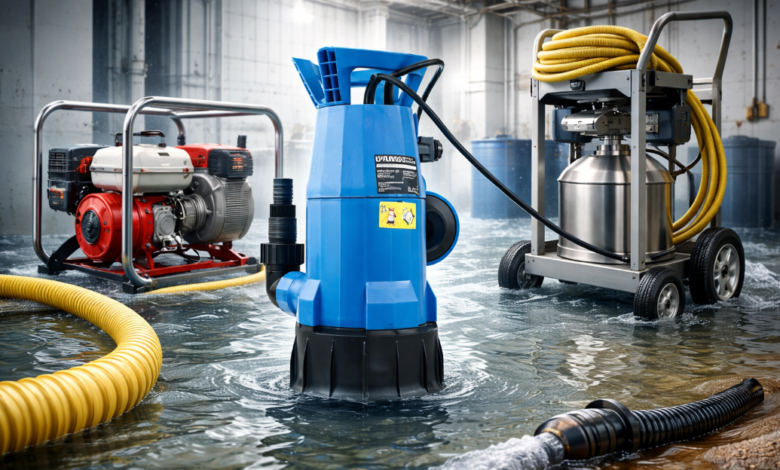
Flooding turns your life upside down in a hurry. Within hours, standing water can soak into floors, walls, furniture and everything. Every minute matters.
Once you begin water removal, the quicker you get the water out, the better chance you have to save your property. However, here’s the problem – not all water removal equipment is created equal. Using the wrong tool can slow you down and even cost you more money in repairs.
Don’t panic. Let’s compare your options. In this guide, we’ll review water pumps vs submersible pumps vs water extraction equipment. We’ll highlight the important differences, so you know which tool to use and when.
What Is a Water Pump?
Water pump is a general term. It can refer to any device that moves water from one location to another. Most traditional water pumps sit above the water level and use suction to draw water up through a hose. You’ve probably seen these pumps at your local hardware store. They’re portable, easy to use, and generally inexpensive.
The downside is they have limitations. Standard water pumps cannot handle deep depths of water. Plus, their suction power decreases if air gets into the hose or if the hose becomes kinked. For those reasons, they work best with minimal flooding. We’re talking one or two inches of water in your garage or basement.
If you’re a typical homeowner that occasionally deals with minor flooding, a basic water pump is an excellent place to start. These pumps are lightweight, easy to transport around your home, and you can use them with either a gas engine or an electric motor. You don’t need any special training to use one either.
What Is a Submersible Pump?
Submersible pumps can operate under water. Instead of sitting above ground and using suction, they push water up and out through a discharge hose while sitting below the waterline. That makes a huge difference for severe flooding.
Because they’re made to be submerged, these pumps can handle deeper depths of water. Many models can handle water that’s several feet deep without any loss of pumping power. Simply drop the pump into the water, connect the discharge hose to a drain or outside your home, and turn it on to let it do the work.
They’re also much quieter than standard water pumps. Since they run underwater, the water filters out much of the motor noise. So, if you find yourself extracting water from your neighbors’ home late at night, the submersible option is much easier on their ears.
Submersible pumps come in various sizes. Smaller models work for residential flooding jobs. Large, high-volume models work for commercial properties or outdoor construction sites dealing with excess water. Point being, there’s likely a size that fits your needs.
Keep in mind these pumps are not meant to push large debris. If you have water that’s mixed with mud, gravel, and other particles, you need a trash pump instead. Regular submersible pumps can easily clog up or even fail if you force it to push debris-filled water.
What Is Water Extraction Equipment?
Water extraction equipment removes water from your property as well. The difference is this equipment is also designed to pull moisture from carpet, carpet padding, flooring, and even walls. Therefore, it’s an essential piece of equipment for any professional restoration company.
Water extractors come in many forms. The most common type you’ll see is either a wet/dry vacuum or truck-mounted extraction unit. Many times, after a flood damage, you’ll see restoration professionals pull up to a home in a large truck. They park the truck near the home and run big hoses into the property. That truck is hooked up to a truck-mounted extractor.
This device has large-powered suction as well as a massive holding tank. It allows the unit to remove water much quicker than your standard pump. Homeowners can purchase small, portable water extractors as well. These machines typically look like oversized shop vacuums. You run them over wet carpet, and the machine sucks the water up through the hose and out of the floor. It’s ideal for water that’s already soaked into your materials.
Here’s why you need extraction equipment – water pumps can only remove water that’s standing on the surface. Once the water level gets below an inch, your pump can no longer remove it. That’s where extraction equipment comes in. It removes water left in carpets, floors, and even walls.
Water pumps vs Submersible Pumps vs Water Extraction: Side-by-Side Comparison
Now let’s make it simple for you. Below is a quick side-by-side comparison of each tool:
Standard water pump
- Best used for: Light flooding
- Position: Works on top of water
- Price: Affordable
- Usage: Easy to use by homeowners
- Limitations: Won’t wick up deep water
Submersible pump
- Best used for: Deep flooding
- Position: Works under the water
- Noise: Quieter than standard pumps
- Limitations: Cannot handle debris
Water extraction equipment
- Best used for: Pulling moisture from impacted materials
- Position: Used after pumps are done
- Professional: Usually used by restoration professionals
- Best for: Carpets, floors, walls
Water pumps vs Submersible Pumps vs Extractors: Which One Do You Need?
It all depends on what you’re dealing with. Let’s say you have a couple inches of standing water in your basement. What do you do? Start with a submersible pump. It will remove the majority of the water quickly. As a result, you lessen the damage to your floors and walls immediately.
Next, you’ll want to switch to an extraction machine. Whether you use a wet/dry vacuum or a portable extractor, you’ll pull up remaining moisture from your carpet and floors. By doing this, you greatly reduce the chance of mold growth inside your home. Mold can develop anywhere between 24-48 hours after a flood happens. Time is of the essence.
If your flooding is minor, you may only need a standard water pump or even a basic wet/dry vacuum. Remember, just because you CAN use the biggest machine doesn’t always mean you should.
When flooding is severe, it may be time to call in a professional restoration company. They have truck-mounted extractors, industrial-strength dehumidifiers, and air movers. Not only will they dry your home, but they can help limit long-term structural damage.
Case Study: “Tiered Response” Applied to a 4 Foot Basement Flood Response
SCENARIO: Basement filled with 4’ of “Category 1” (clean) water, caused by storm event.
THE PROBLEM: Customer attempted to cut a carpet-company rug with a large shop vac…couldn’t suck a rolling river at 3 minute intervals.
THE “TIERED RESPONSE” APPROACH:
Phase 1 (“Bulk Removal”) : Lay down your big gun (Submersible Pump). Get that puppy down to floor level. Have it running while you move onto step two. In this case, it removed 95% of the water in 5 hours. A horizontal distance of 20′ away from the foundation kept us from pumping water INTO the foundation.
Phase 2 (“Detailing”) Once you have about 1″ of standing water, your submersible pump “loses its prime.” Switch tools and attach a suction head to your trusty Standard Utility Pump to vacuum up puddles.
Phase 3 (“Extraction”) : To prevent costly replacement of the concrete floors and bottom plate of your basement walls, bring in a Water Extractor (aka Industrial Strength Vacuum). It literally extracts the “wicked” moisture from within these porous surfaces.
THE OUTCOME: With a proper understanding of what tool to deploy at various depths, this basement was ready for dehumidification in less than 12 hours. Complete job. No structural shifting or mold to be concerned about.
Got Questions?
Why can’t I just rent a submersible pump and leave it overnight?
Submersibles are the “heavy lifters”, but they do have limits. Most have a physical limit of 1 to 2 inches before the motor can no longer cool itself and maintain suction. Once the water level gets down to that height, your pump will suck air instead of water. That is when you want to “tag in” another piece of equipment, like a Water Extractor or wet-vac to remove that last remaining moisture.
Will my standard water pump “wick” up the mud on the bottom of my flooded basement?
Think of most submersibles and standard water pumps as “clear-water” machines. If your basement flood has ground debris (silt), leaves, or years of “basement gunk” (say that 3 times fast) you will burn out your pump by clogging the mechanical impeller. When you have that type of water, you need a Trash Pump. Trash pumps have a special type of impeller called a “vortex impeller”. This design allows solids up to a half inch in diameter to get chewed up and spit out without killing the pump.
Does “Extraction Equipment” just mean Shop-Vac?
Kind of. Shop-Vacs are technically Water Extractors because they create “negative” pressure (suction) when the trigger is pulled. However, professional Water Extractors have many more pounds of lift (vacuum power). The difference is similar to someone swinging a hand broom versus an industrial vacuum. A shop-vac will pick up the water that is laying on top of your floor, but an extractor can pull water out of carpet padding or concrete slab pores. It won’t cut holes in your carpet to do it though…
I thought sticking a submersible pump in a flood was dangerous? Electrical shock and all that?
Yes and no. If you submerge any electrical device in water you are inviting risk into your house. BUT, submersible pumps have been built with safety in mind. They are “hermetically sealed”. This means the motor itself is placed inside a waterproof container. To play it EXTRA safe, plug your pump into a GFCI protected outlet. If any electrical short is detected, the outlet will shut off power in milliseconds preventing you from getting shocked.
When do I throw in the towel and call someone with a truck-mounted extractor?
If the water has sat for more than 24 hours OR you can’t see your feet because the water is up past your ankles…call a professional. The heavy-duty suction power in truck-mounted units can dry out your home quickly. Always remember, the longer water sits, the farther it moves into your wall studs. You might be able to see the water at your door, but it has probably wicked up your walls twice that height! If it’s in the wood, you can’t pump it out…you have to extract it.
Final Words
Water damage isn’t fun, but having the right tools can make all the difference. Water pumps are great for removing most of the water from your home. However, they work best when the water is shallow. Submersible pumps can handle deeper water with ease. Finally, water extraction equipment is used to pull moisture from your floors and walls.
Use them together, and you have a one-two punch that floods won’t stand a chance against. Remember, your response time can impact how much water damage you suffer.