

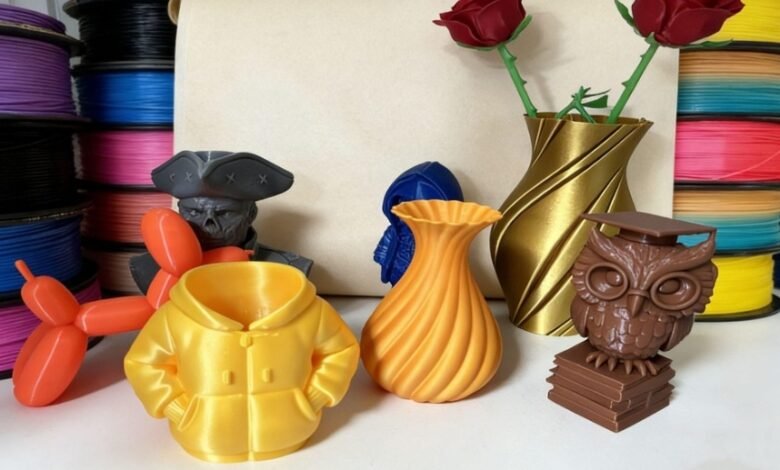
3D printing has revolutionized prototyping, manufacturing, and creativity in hobbies. Filament is the material that is vital in the center of every successful print. Although settings in the printer and the files that you design are significant, the actual basis of the quality of print and structural integrity is the type of PLA filament used and its quality.
With the knowledge of the PLA filament’s effect on surface finish, strength, layer adhesion, and durability, you will be in a position to make uniform and high-performance prints. The difference between success and failure in your work is the right choice of material, whether you are a professional manufacturer or a hobbyist perfecting your craft.
Introduction to PLA Filament and Its Composition
PLA filament (Polylactic acid) is one of the most common materials in FDM (Fused Deposition Modeling) 3D printing. It is also made with renewable materials like corn starch or sugarcane, which makes it better for the environment compared to most petroleum-based options.
It enjoys popularity due to the following benefits:
- Reduced printing temperature requirements
- Minimal warping
- Smooth surface finish
- Ease of use for beginners
- Extensive color and finish choices
Not every filament is equal, however. When the purity of the raw materials, manufacturing uniformity, and tolerance in diameter, as well as moisture, vary, there is a direct effect on the print quality and mechanical strength.
The Effect of Filament Diameter Accuracy on the Quality of Print
Filament’s diameter consistency is one of the basic aspects considered in 3D printing. The majority of printers are adjusted to 1.75mm or 2.85mm filament. The slightest misalignment is capable of interrupting extrusion flow.
In case of inconsistency of diameter tolerance:
- It leads to blobs and rough surfaces as a result of over-extrusion
- Weak layers and gaps get formed under-extrusion
- Time dimensional accuracy is reduced
- Integrity of the structures is lost
PLA filament of high quality has a high level of tolerance in the diameter, which means that extrusion and results are consistent. The consistency of the flow of materials directly influences the bonding of the layers, and this is critical to print strength.
The Effect of Layer Adhesion on Strength
Any FDM print is based on layer adhesion. Since 3D printing is a process of the formation of objects in layers, there should be a proper connection of the layer to the previous one.
PLA filament affects adhesion in several ways:
1. Stability at the Melting Temperature
When the melting of the filament is even and continuous, then it flows smoothly and is adhesive among layers. The quality of material used can also be poor, resulting in inconsistent melting and thus weak internal bonding.
2. Material Purity
Layers may not fuse correctly due to impurities or uneven mixing of polymers. This gives prints that crack along the lines of stress.
3. Cooling Characteristics
PLA is cooled at a low rate. Quick flow and cooling are also crucial in producing high-quality filament that could achieve maximum interlayer bonding without deforming the print.
The greater the adhesion between the layers, the higher the tensile strength, impact resistance and the life of the printed parts.
Surface Finish and Visual Quality
The initial property of filament performance that is commonly seen is surface quality. Premium PLA filament yields:
- Smooth outer walls
- Evenly spaced color division
- Reduced stringing
- Minimal surface artifacts
On the contrary, can cause:
- Rough textures
- Uneven extrusion lines
- Zits and blobs
- Color inconsistencies
Surface finish is aesthetic as well as influences part functionality. Rough surfaces may enhance friction, diminish dimensional accuracy, and develop weak points in the mechanical parts.
Absorption of Moisture and Effect on the Strength of Print
PLA filament absorbs moisture in the air, thus making it hygroscopic. Humidity may greatly decrease the quality of prints and structural performance.
When a wet filament is printed:
- When greeting, steam bubbles are formed
- Layer bonding weakens
- Surface becomes rough
- Prints become brittle
Dry filament extrusion is cleaner and offers better bonding within. The correct storage in closed containers with desiccants guarantees the stability and consistency of strength.
Mechanical Performance and Print Temperature
The temperature used in printing is a significant factor that impacts the ultimate strength of PLA components. Most PLA melts between 180 and 220 ℃; however optimum temperature varies with the formulation used.
The possible effects of lower temperature include:
- Poor layer adhesion
- Brittle parts
- Under-extrusion
The increased temperatures may lead to:
- Stringing
- Decreased dimensional accuracy
- Surface defects
With proper temperature optimization of your filament, the material will flow well and bond well to give you better tensile and impact strength.
Infill, Layer Height and Structural Durability
Although the quality of filament is important, the print settings should also be taken into consideration. The filament PLA reacts differently during printing.
Infill Density
The higher the percentage of infill, the higher the structural strength and the more material consumed. Powerful PLA filament is such that even moderate infill structures can withstand it.
Layer Height
Reduced layer height enhances surface finish and could enhance the bonding of layers. This, however, is dependent on the capability of the filament to sustain constant extrusion even at the finest resolutions.
Print Speed
When the filament is of high quality, it allows faster printing without loss of bonding strength. Lower-grade material might not be able to withstand high speed, resulting in weak spots.
Mechanical performance of the final object will depend on the interaction that exists between the filament properties and the printer settings.
Stability and Prolonged Performance
PLA filament is hard and, in comparison to other materials, is less resistant to heat. Nevertheless, quality plays an important role in the performance in the long term.
Superior PLA filament has the following advantages:
- Consistent rigidity
- Reduced brittleness
- Improved crack-resistant behavior
- Stable dimensions over time
Poor quality filament can be easily broken, particularly when it is subjected to stress in the form of moisture or moderate temperature.
In the case of practical components, models, or decorative objects requiring durability, uniformity of materials is imperative.
Additives: Color Additives and Their Effect on Strength
Color is one of the factors chosen by many users of PLA filament. Mechanical properties can, however, be affected by pigment.
Black and intensely colored filament can:
- Absorb heat differently
- Demand minor changes in temperature
- Affect bonding consistency
Additional compounds are common in specialty finishes like silk, PLA, glow-in-the-dark or matte. These can lower the tensile strength in relation to normal PLA.
In case the structural strength is a priority factor, the neutral or natural PLA filament tends to work most effectively.
Production Quality and Brand Credibility
All manufacturers of filaments do not share the same standards of production. Reliable brands invest in:
- Constant extrusion calibration
- Moisture-controlled packaging
- High-purity raw materials
- Pre-shipment quality testing
The low cost of filament might appear desirable, but variability usually results in incorrect prints, wastage of time, and weakened quality.
Selecting reliable PLA filament minimizes the problems with troubleshooting and results in predictability.
Environmental Factors That Influence PLA Prints
In addition to the quality of the materials, there are the environmental conditions that have an impact on performance.
Ambient Temperature
Low temperatures may lead to quick cooling and slower adhesion of layers.
Airflow
Layers can be cooled too fast by strong airflow or fans, which reduces bonding.
Storage Conditions
Exposure to humidity before printing has a direct effect on strength and surface quality.
Knowing the ways in which the filament reacts to the environmental circumstances will enable you to optimize the power and the quality of the finished product.
Comparison of PLA Filament and Other Materials
PLA filament is not the most powerful 3D printing material in the market, but it provides a good combination of convenience, quality of the surface, and mechanical stability.
Compared to ABS:
- Easier to print
- Less warping
- Better surface finish
Compared to PETG:
- More rigid
- Slightly more brittle
- Better for detailed prints
Most everyday applications do not require much strength, and when printed properly using high-quality material, PLA filament will be strong enough.
Professional Tips to Optimize Print Strength
To accomplish steady strength and quality results:
- Install high-quality filament and be strict in tolerance
- Keep filament in dry, non-sealed containers
- Test and optimize print temperature
- Temperature: Change cooling settings to enhance adhesion between layers
- When it is necessary to have a greater strength, do not use extremely fast print speeds
- Proper use of the infill density of structural parts
These are the measures that make sure that your filament is at its optimal level.
The Reason Why Material Choice Is the Key to the Success of Printing
There are lots of users who pay much attention to upgrades of the printers, state-of-the-art slicer preferences, or mechanical adjustments. Nevertheless, the easiest option for enhancing the quality of 3D printing is choosing higher-quality filament.
The stability of PLA filament has a direct impact on:
- Surface finish
- Dimensional accuracy
- Layer adhesion
- Tensile strength
- Durability
As long as the material is dependable, all other variables will be simpler to manage.
Conclusion
PLA filament is not a simple printing material. All objects manufactured through FDM 3D printing use it as the structural base. It is the quality of the print that makes a print either smooth or rough and strong or brittle, durable or fragile.
Diameter consistency and moisture control, temperature optimization, and pigment composition are only some of the features of PLA filament, which affect the result in terms of print strength and performance. Good filament provides better bonding of the layers, smooth surfaces, and structural reliability over a long period.
Material selection can never be an afterthought if your goal is consistent and high-performance 3D printing. It has been shown that by investing in a dependable PLA filament, not only can the surface finish and dimensional accuracy be enhanced, but also the strength and durability can be maximized. In the 3D printing space, improved filament translates to improved outcomes – with each usage.