

Introduction: Solving the Subdomain Security Puzzle
Managing a website often feels like tending to a rapidly growing garden. What starts as a single homepage quickly branches out. You add a blog to share news, a shop to sell products, and perhaps a secure login portal for your team. Before you know it, you are managing a complex ecosystem with addresses like blog.yoursite.com, shop.yoursite.com, and portal.yoursite.com.
In the world of web security, each of these addresses is distinct. Traditionally, securing them would mean buying and installing a separate SSL certificate for each one. This approach is not only expensive but also a logistical headache for IT teams. Managing expiration dates and renewals for a dozen different certificates is a recipe for errors and security lapses.
This is where wildcard SSL certificates offer a powerful solution. They are designed specifically to handle the complexity of modern website structures. By allowing you to secure a primary domain and an unlimited number of its subdomains under a single certificate, they simplify administration and cut costs significantly. If you are looking to scale your online presence without multiplying your workload, understanding wildcard SSL certificates is the first step toward a more efficient security strategy.
How Wildcard SSL Certificates Work
To understand the value of wildcard SSL certificates, it helps to understand the problem they solve. A standard SSL certificate is strictly bound to a single Fully Qualified Domain Name (FQDN), such as www.example.com. If you try to use that same certificate on mail.example.com, web browsers will reject it, warning visitors that the connection is not secure.
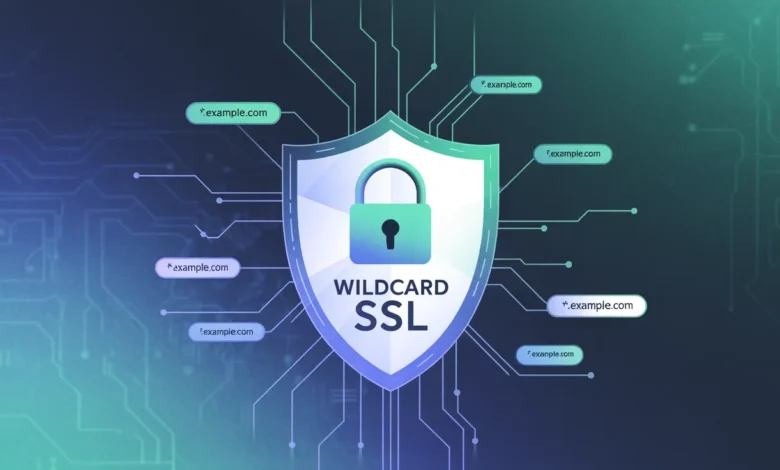
A wildcard certificate changes the rules by using a special character during the creation process. When you generate a Certificate Signing Request (CSR) for a wildcard certificate, you place an asterisk (*) before your domain name. For example, the common name on the certificate becomes *.example.com.
In technical terms, the asterisk acts as a variable. It tells the browser that this certificate is valid for the main domain and any subdomain at that specific level.
If you purchase a certificate for *.example.com, it will automatically secure:
- example.com
- example.com
- example.com
- example.com
- example.com
It is important to note that wildcard SSL certificates generally secure only one level of subdomains. If you have a second-level subdomain, such as test.login.example.com, a standard wildcard certificate for *.example.com might not cover it. However, for the vast majority of business needs, the single-level coverage is exactly what is needed to ensure comprehensive security.
The Strategic Benefits of Using Wildcard SSL Certificates
Switching from individual certificates to wildcard SSL certificates brings immediate and tangible benefits to your organization. It is not just about convenience; it is a smart financial and operational decision.
- Unified Management and Efficiency
The biggest advantage is simplicity. Managing SSL certificates can be tedious. You have to generate a CSR, undergo validation, install the files, and track the expiration date. Now, imagine doing that 15 times for 15 different subdomains. It drains time and resources.
With wildcard SSL certificates, you perform these tasks once. You manage one certificate, one expiration date, and one renewal process for your entire fleet of subdomains. This significantly reduces the administrative burden on your IT staff, freeing them up to focus on more critical tasks.
- Significant Cost Reduction
While the upfront price of a wildcard certificate is higher than a single-domain certificate, the math works in your favor as soon as you have multiple subdomains. Buying ten separate certificates will almost always cost more than buying one wildcard certificate. Furthermore, because a wildcard allows for unlimited subdomains, your cost-per-domain decreases every time you launch a new section of your site. It is a fixed cost that delivers increasing value as you grow.
- Future-Proof Flexibility
Business moves fast. You might need to launch a new marketing landing page (promo.yoursite.com) or a testing environment (beta.yoursite.com) on short notice. If you rely on single-domain certificates, you have to stop, purchase a new certificate, wait for validation, and then install it. This delays your launch.
With wildcard SSL certificates, the infrastructure is already in place. Because the certificate covers *.yoursite.com, any new subdomain you create is secured instantly from the moment it goes live. You don’t need to buy anything new or reconfigure your validation; you just deploy and go.
Industries and Use Cases Where Wildcard SSL Certificates Shine
While any website owner with more than one subdomain can benefit, certain industries find wildcard SSL certificates practically indispensable.
E-Commerce and Retail
Online stores often separate their functions to improve site performance and security. The main catalog might live on www.store.com, while the checkout process happens on secure.store.com, and customer account management is on my.store.com. Maintaining trust is critical in retail. A wildcard certificate ensures that the padlock icon remains visible and consistent across every step of the customer journey, preventing cart abandonment due to security fears.
Software Development and QA
Developers constantly create temporary environments to test code before pushing it to the live site. They might use addresses like dev.app.com, staging.app.com, or test-v2.app.com. These environments need to mimic the production environment, which means they need HTTPS. Wildcard SSL certificates are perfect here because developers can spin up as many test environments as they need without requesting budget approval for new certificates every time.
Large Enterprises and Corporations
Big companies often have different subdomains for different departments (hr.corp.com, sales.corp.com) or regional offices (uk.corp.com, ny.corp.com). A wildcard certificate allows the central IT department to secure all these diverse internal portals with a single solution, ensuring consistent encryption standards across the entire global organization.
Conclusion: A Smart Investment for Scalable Security
In the digital landscape, efficiency and security must go hand in hand. As your online presence expands, the old method of buying a certificate for every new page becomes unsustainable. Wildcard SSL certificates offer an elegant, powerful alternative. They provide the robust encryption required to keep user data safe while offering the flexibility to grow your infrastructure without hurdles.